
Tag: meditation

  • Is There a God? How Finding My Belief in a Higher Power Reshaped My Practice

    Is There a God? How Finding My Belief in a Higher Power Reshaped My Practice

    When I first entered the world of recovery, the phrase “Higher Power” felt foreign, almost unapproachable. In the early days of working a 12-step program, I wrestled with the idea of surrendering to something greater than myself. As someone who had relied on grit, resilience, and control to navigate life’s challenges, the concept of letting go felt like a contradiction to everything I knew. But I was desperate for change, and that desperation became the fertile ground where my understanding of a Higher Power began to grow.

    In the beginning, my Higher Power wasn’t a deity or a cosmic force. It was the people I trusted. My sponsor, the community of recovery meetings, and the friends who believed in something greater than themselves—they became the scaffolding for my faith. I borrowed their belief when I didn’t have any of my own. Their stories of surrender, resilience, and hope were my foundation. They reminded me that I didn’t have to know all the answers, and that simply trusting the process was enough to start.

    Over time, as I moved through the steps, something began to shift. It wasn’t an overnight revelation but a gradual awakening. I began to notice how prayer and meditation opened doors within me that I didn’t know existed. My prayers were simple at first: a whispered plea for strength or a moment of gratitude for getting through another day sober. Meditation, too, was a challenge initially—my thoughts raced, and silence felt intimidating. But as I continued to show up for those practices, I started to feel a connection I couldn’t explain. It was as if the act of seeking created a space for grace to enter.

    Around this time, I picked up Eckhart Tolle’s A New Earth. The book articulated something I had started to sense but couldn’t yet put into words: the idea that we are all connected, both to each other and to a universal Oneness. Tolle’s exploration of ego, presence, and interconnectedness resonated deeply with me. It wasn’t just about finding peace within myself; it was about understanding that I’m part of something much larger. This realization didn’t diminish my individuality—it gave it purpose. I began to see the divine not as a distant figure but as the thread that weaves through all of existence, connecting us in ways both visible and unseen.

    Today, my belief in a Higher Power is an integral part of my daily life. Prayer and meditation are no longer just tools for coping; they are ways to align myself with that universal Oneness. Through them, I’ve come to see life as purposeful, even when it’s painful. Tragedy, I believe, is not without meaning. It creates opportunities for those who experience loss to transform their healing journeys into sources of strength and connection. When I reflect on the hardest moments of my life, I see how they have shaped my ability to empathize with others. My pain has given me the language to connect, the wisdom to guide, and the courage to share my story.

    This belief in a Higher Power has reshaped not just my recovery but my entire approach to life. I no longer see challenges as obstacles to be conquered but as opportunities to grow and connect. I believe we are here to support one another, to learn from each other, and to contribute to the collective healing of the world. This perspective has not only deepened my personal practice but has also informed how I approach my work, my relationships, and my advocacy for mental health and first responders.

    If you’re struggling with the idea of a Higher Power, I want you to know that it’s okay to start small. Borrow the faith of others if you need to. Begin with curiosity rather than certainty. And trust that the journey itself will reveal what you need to know, one step at a time. For me, finding a Higher Power wasn’t about adopting someone else’s definition of God; it was about discovering the divine within myself and the world around me. That discovery continues to shape me, and for that, I am profoundly grateful.

  • How to Use the 5 Blinks Method to Overcome Intrusive Traumatic Images

    How to Use the 5 Blinks Method to Overcome Intrusive Traumatic Images

    Intrusive images and flashbacks can feel overwhelming and disorienting, but the 5 Blinks Method is a quick and effective technique to regain control of your mind and focus on the present. This simple practice uses a combination of grounding and mindfulness to help redirect your attention and soothe your nervous system. This technique was introduced to me by a licensed therapist, and has been extremely helpful for me when I’ve dealt with traumatic calls and scenes, both in the field and in the hospital.

    Step-by-Step Guide to the 5 Blinks Method

    1. Identify the Intrusive Image

    • When you notice an intrusive image or memory, acknowledge it without judgment.

    • Say to yourself: “This is just a thought, not my reality right now.”

    2. Take a Deep Breath

    • Inhale deeply through your nose for 4 seconds, hold for 4 seconds, and exhale slowly through your mouth for 6 seconds.

    • This activates the parasympathetic nervous system to help you calm down.

    3. Blink Five Times Slowly

    • Blink deliberately and slowly five times.

    • Each blink acts as a symbolic “reset” for your brain, helping to break the cycle of intrusive thoughts.

    4. Visualize Sending the Image Away

    • Close your eyes.

    • Imagine the intrusive image as a photograph, or a film reel- an object or something tangible.

    • Now imagine a box big enough to fit the image-object.

    • Visualize placing the image-object into the box and sending that box as far away in your mind as possible, watching it get smaller and smaller, until it completely disappears in the distance.

    Take a deep breath

    5. Blink Five Times Slowly

    • Blink deliberately and slowly five times.

    • Repeat a grounding statement or positive affirmation to yourself, such as:

    • “I am here in this moment.”

    • “I did everything I could.”

    • “Life happens on life’s terms.”

    6. Ground Yourself in the Present Moment

    • With your eyes open, identify five things you can see.

    • Say them out loud or in your mind.

    7. Move a Muscle, Change a Thought

    • Find something that you can focus your entire attention on- something physical such as going for a walk outside, cleaning something, or opt for a quick workout. Physical activity has a number of benefits, including grounding yourself in your body, releasing endorphins, and even boosting serotonin.

    • Other mind-consuming activities can help too- like playing a game on your phone, having a conversation with someone, or watching an interesting show or movie.

    8. Repeat as Many Times as Needed

    • If the image is resistant and continues to intrude, repeat steps 1-6 as many times as needed, while still trying to find something you can completely and mindfully focus on.

    Additional Tips for Success

    Practice Regularly: The more you use the 5 Blinks Method, the quicker your brain will recognize it as a tool to refocus.

    Pair with Deep Breathing: Combining the method with paced breathing enhances its calming effect.

    Use a Support Object: Hold a grounding object, like a smooth stone, while practicing. (I use a short piece of thin rope that has a knot tied on one end- because when you get to the end of your rope, you tie a knot and hold on!)

    Other Distress Tolerance Techniques to Explore

    The 5 Blinks Method is just one of many strategies to manage distress and intrusive thoughts. Stay tuned for future posts where we’ll explore other effective techniques:

    1. TIPP Skills – Using temperature, intense exercise, paced breathing, and paired muscle relaxation to lower emotional intensity.

    2. Grounding Techniques – Detailed practices like the 5-4-3-2-1 method and body scans.

    3. Opposite Action – Redirecting overwhelming emotions by taking an action opposite to the urge.

    4. Distraction Toolkit – Creating a personalized box or bag of items and activities to help refocus during moments of distress.

    5. Mindful Visualization – Replacing intrusive images with a safe or peaceful mental scene.

    Final Thoughts

    The 5 Blinks Method is a powerful, portable tool to help you navigate intrusive traumatic images. It works by engaging your senses and redirecting your focus, allowing you to move forward without being stuck in the past. Remember, it’s okay to seek additional support from a trusted counselor or peer support group as you work through these challenges.

    You’ve got this—one breath at a time.

  • Finding Peace in the Wild: How Nature Became My Mental Health Sanctuary

    Finding Peace in the Wild: How Nature Became My Mental Health Sanctuary

    As first responders, we often find ourselves living in the fast lane, constantly on alert, managing crises, and navigating high-pressure situations that demand our focus, skill, and resilience. In the midst of this chaotic work life, I have found that one of the most essential tools in managing stress and maintaining my mental health has been connecting with nature.

    My journey to finding peace in the wild didn’t happen overnight, but as I’ve experienced the therapeutic power of the natural world, it has become an integral part of my self-care routine—something I actively seek out for restoration, clarity, and healing. Whether it’s a short walk along a river or an extended camping trip in the woods, these moments in nature have become my sanctuary, offering a sense of grounding that helps me process the emotional toll of my EMS career.

    Outdoor Experiences That Provide Peace and Clarity

    One of the most accessible places for me when time is short is the Androscoggin Riverwalk, in Lewiston-Auburn, and the Bragdon Hill Conservation area in Poland, ME. I’ve found that even a brief walk along the riverbanks or forest offers a mental reset, allowing me to pause and absorb the sights and sounds of the flowing water and wildlife. There’s something calming about the rhythm of the river, or a narrow trail, and it provides me with the space to let go of the stresses of the day.

    When I have more time, I often head to Mount Apatite or Streaked Mountain for a quick hike. The physical activity combined with the natural beauty of the forest helps to clear my mind and refresh my body. Hiking is a great way to disconnect from the noise of everyday life and connect with something much bigger than myself.

    For days when I need a longer getaway, I take a drive to the ocean, where the salty air and waves crashing against the rocks create the perfect environment for reflection. Fort Williams Park, in particular, is a favorite destination of mine. The trails are scenic and lead me to a rocky beach where I can listen to the waves tumbling over the stones. The sound is unlike anything else—it’s soothing, like nature’s own meditation.

    Screw Auger Falls in Newry, Maine, and the areas around the University of Southern Maine in Portland are other spots that I treasure, especially when I want to explore new places for creative inspiration, such as finding seaglass. These small treasures serve as a reminder that, even in the chaos of life, beauty can be found in the simplest moments.

    Technology-Free Camping for Deep Restoration

    When I’m able to get away for a longer stretch of time, there’s nothing more restorative than technology-free camping in the areas surrounding Rangeley, Maine. With no cell service, I am fully immersed in the natural world—no distractions, no screens. It’s just me, the sounds of the forest, and the peaceful serenity of being completely present.

    Some of my favorite activities during these camping trips include campfire meditations, kayak fishing, and paddleboarding. There’s something about being on the water, surrounded by quiet, that allows me to truly connect with myself. Whether I’m sitting quietly by a lake, a trickling stream, or gazing out at the ocean, these moments allow me to reflect and breathe deeply.

    Using Nature for Meditation

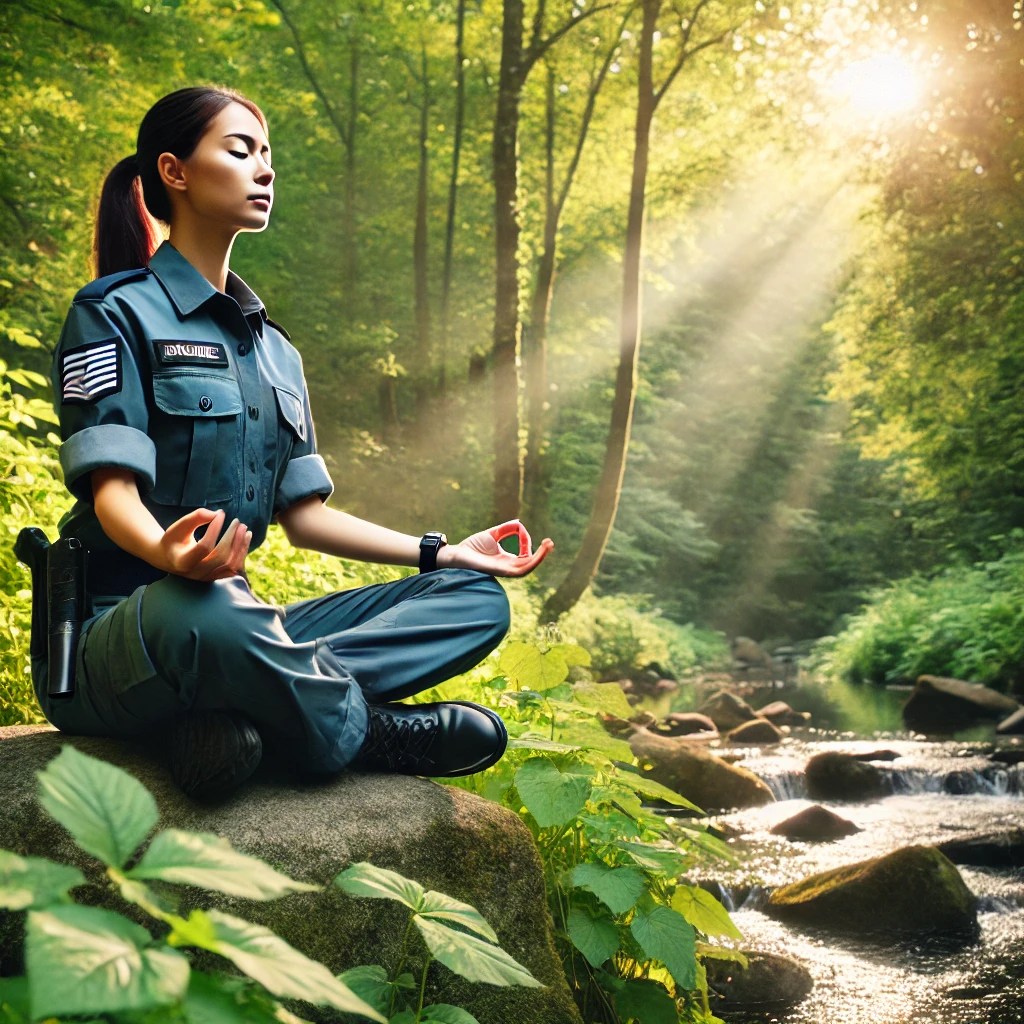
    Nature has become key to my meditation practice. The external sounds of the forest, the river, or the ocean provide a natural backdrop that helps me center my thoughts and focus. I use the sounds of birds chirping, water flowing, or waves crashing to quiet my mind and ground myself in the present. These moments of stillness in nature give me the mental space to process the trauma and stress of my job, while also reminding me of the peace that exists outside of the chaos.

    When I can’t physically be in nature, I’ve found solace in guided meditations with nature sounds or handpan music. Some of my favorite guided meditations can be found on YouTube, and I highly recommend them for anyone seeking a moment of calm. Here are a few of my go-to meditations:

    Tips for First Responders: Using Nature as a Healing Space

    If you’re a first responder like me, nature can be one of the most powerful tools for managing stress and enhancing mental health. Here are a few tips on how to incorporate nature into your healing routine:

    1. Start Small: If you’re pressed for time, a short walk in a local park or along a riverbank can offer a quick mental reset. Even five minutes can help clear your mind and alleviate stress.
    2. Make It a Habit: Schedule regular outings to nature, whether it’s a weekly hike, a monthly camping trip, or even a daily walk. Consistency helps train your mind to relax and find peace in nature’s rhythms.
    3. Embrace Technology-Free Time: Turn off your phone and leave your digital devices behind. Technology-free moments in nature help you focus on the present and disconnect from external pressures.
    4. Practice Nature-Based Meditation: Use the sounds of nature to guide your meditation practice. If you can’t get outside, seek out guided meditations that feature natural sounds like water flowing, wind blowing, or birds chirping.
    5. Engage in Outdoor Activities: Whether it’s hiking, kayaking, or simply sitting quietly by a stream, engaging in outdoor activities can provide both physical and mental restoration. Find what brings you peace and make time for it.

    Nature has become a sanctuary for me—a space where I can breathe, reflect, and find clarity. It offers a moment of respite from the chaos of my EMS career and provides the mental and emotional restoration I need to continue my work. As first responders, we give so much of ourselves to others, but we must also prioritize our own well-being. Nature has taught me that healing is possible when we take time to reconnect with the world around us, and I hope it can offer the same sense of peace and restoration to you.